Guide
Fabricating Large Curved Metal Panels: Rolling, Forming and Finishing
Curved panels make the architecture and concentrate the fabrication risk. How large-radius metal panels are rolled and formed, why curvature and finish interact, and what to check before approval.
Curvature concentrates the difficulty
Flat panels forgive. Curved panels do not. A gentle radius across a wall or ceiling reads as architecture; it also means every downstream operation — forming, welding, finishing, inspection, packing — works on a geometry that no longer references itself flat. The panel cannot be checked on a flat table, the finish cannot be polished with flat tools alone, and a distortion that would hide in a flat field becomes visible as waviness in the reflection of a curved one.
Large curved metalwork — feature walls, vaulted ceilings, column covers, curved screens and facade panels — is therefore a specialty discipline inside custom fabrication. This article sets out how the work is actually done and what determines quality.
The forming routes
Rolling. The classic route for single-curvature panels: the sheet passes through a three- or four-roll machine, adjusting curvature in passes. Plate rolling produces smooth, continuous radii and suits large wall and ceiling panels; the operator controls springback by feel, iteration and measurement.
Press-brake forming. CNC press brakes form straight-line bends — the building block of faceted curves. A curved surface approximated by many narrow flat segments can be more economical than true rolling, and for faceted design languages it is the intended method, not a compromise.
Incremental and specialised forming. For tighter radii or compound (two-direction) curvature, forming happens locally — sequential bends, lancing and relief cuts, or dedicated tooling. Compound curvature is where cost climbs: the material has to actually stretch or compress, and the surface will show every unevenness of that process.
Segmentation. Very large curved assemblies are built as coded segments joined along design joints, then verified in factory assembly. The logic of where to split large work is covered in how stainless steel panels are split for large installations; for curved work the same reasoning applies with the added constraint that joints should follow the design's curvature rhythm, not fight it.
Springback and material behaviour
Sheet metal springs back after forming — the formed radius relaxes away from the tool radius, by an amount that depends on material, temper and thickness. Curved fabrication is therefore an iterative discipline: roll, measure, correct. Two consequences matter to specifiers:
- Curved panels of different thicknesses or materials will not match unless the fabricator explicitly compensates. A 2.0 mm panel and a 1.5 mm panel formed to "the same" drawing radius will read as different radii after springback.
- Consistency across a run — dozens of panels forming one continuous ceiling or wall — depends on process control: same machine, same operator sequence, same measurement checks. The batch-consistency mindset that governs PVD colour applies to geometry as well.
Curvature and finish interact
The forming sequence relative to finishing is a real decision. Grinding and polishing tools prefer flat or simple surfaces; aggressive re-work on a formed panel can flatten the curve locally. Best practice forms first and finishes second, with finishing done through progressive stages that follow the curve, and with distortion checked at raking light between stages.
Brushed finishes on curved work are particularly exposed: the grain direction wraps the curve, and any local re-blending (at welds or corrections) must continue the grain trajectory, not restart it. On mirror work, curvature becomes an optical instrument — every wave in the panel appears magnified in reflections. The craft of blending and inspection on such surfaces is the same discipline described in seamless welded corners.
Assembly and interface checks
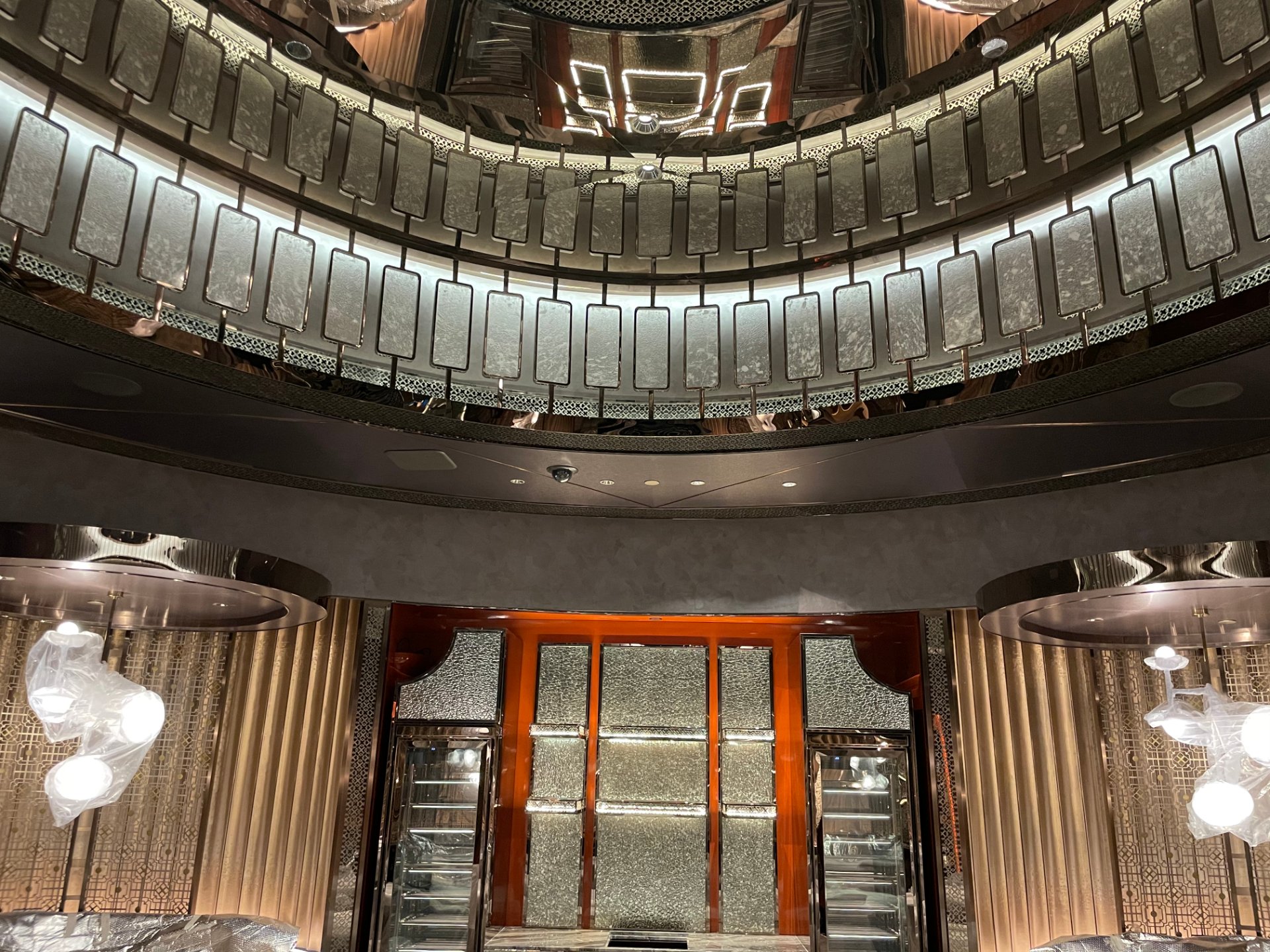
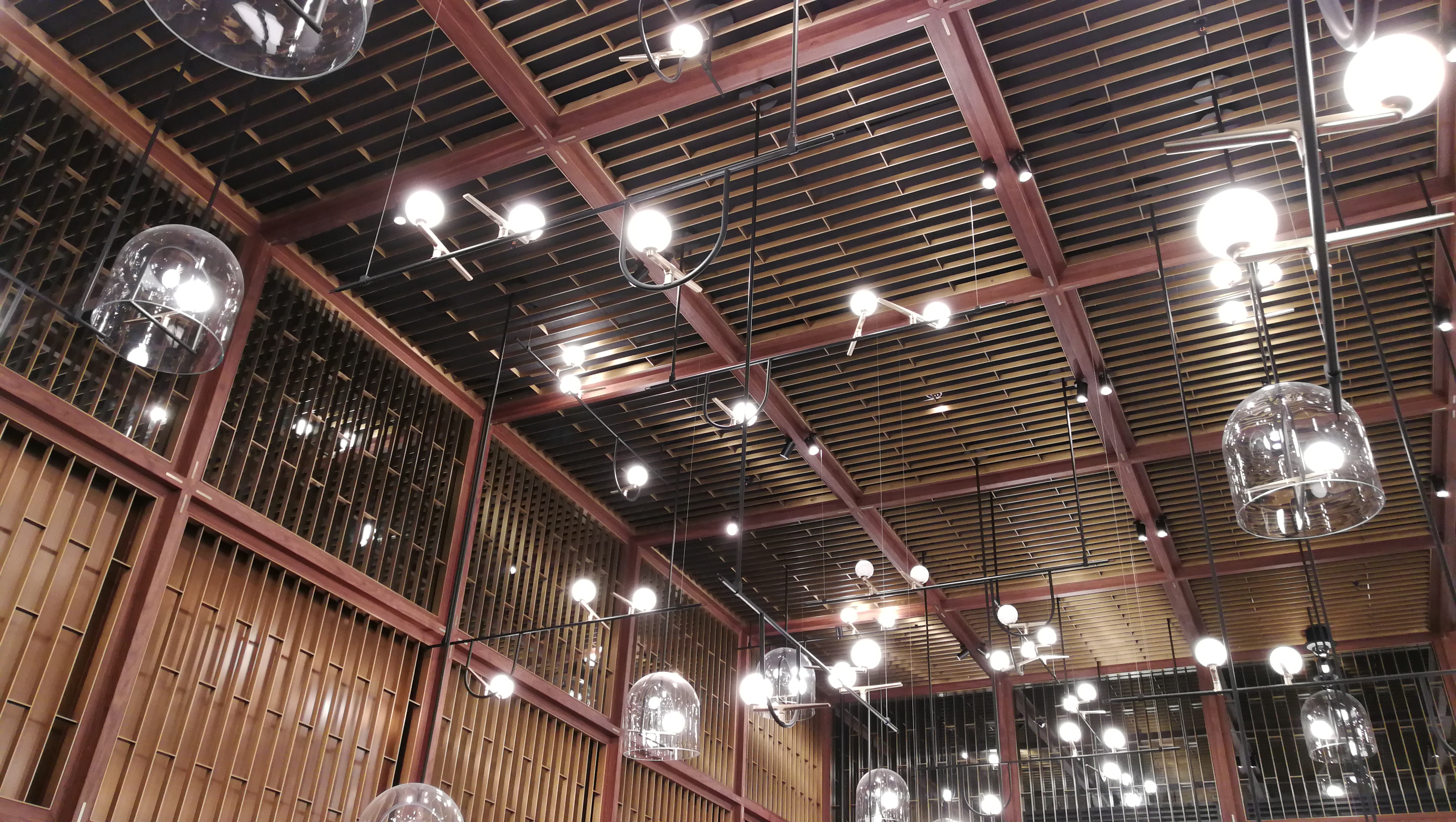
Curved packages almost always meet other curved things — a vaulted ceiling meeting curved walls, a curved screen meeting a straight floor line, panels meeting glass set to a different tolerance philosophy. The fabrication-side answer is factory trial assembly: the curved assembly is built and checked in the workshop, interfaces verified against the parts that will surround them, and corrections made while parts are still on the bench. On KingDeco's curved packages — from the curved brass cladding coordination described in engineering coordination for complex curved brass cladding to the vaulted ceiling of the MESA restaurant package — trial assembly is where geometry risk is retired, before anything ships. The general case is covered in factory pre-assembly of architectural metal components.
Packing and transport for curved work
A curved panel is structurally different from a flat one: stiffness varies with orientation, and a panel that survives flat shipping can distort in curved shipping if supported at the wrong points. Curved work is crated on form-fitted supports holding the true shape, so transport loads bend nothing. The broader packing discipline for oversize decorative metalwork is covered in how large decorative metalwork is packed for overseas projects.
What to verify before approving curved fabrication
Before production release on a curved package:
- A formed sample or first article, in the actual material and finish, approved as the geometric and visual reference.
- The segmentation drawing, showing design joints and the panelisation logic.
- The tolerance philosophy at interfaces — where curved metal meets glass, stone or lighting, agreed in writing.
- The assembly-check plan — confirmation that the curved assembly will be trial-assembled in the factory, with interface checks against adjacent scopes.
If your design includes large curved metal panels — walls, ceilings, screens or facades — and you want a fabricator with in-house rolling, forming and trial-assembly capability, discuss your project with KingDeco — send us your drawings for a technical review and quotation.