Guide
Component Traceability: Managing Thousands of Unique Custom Metalwork Parts
On a bespoke metalwork package every part is a one-off. How coding systems link drawings, parts, crates and installation positions — and why that decides how fast problems get solved.
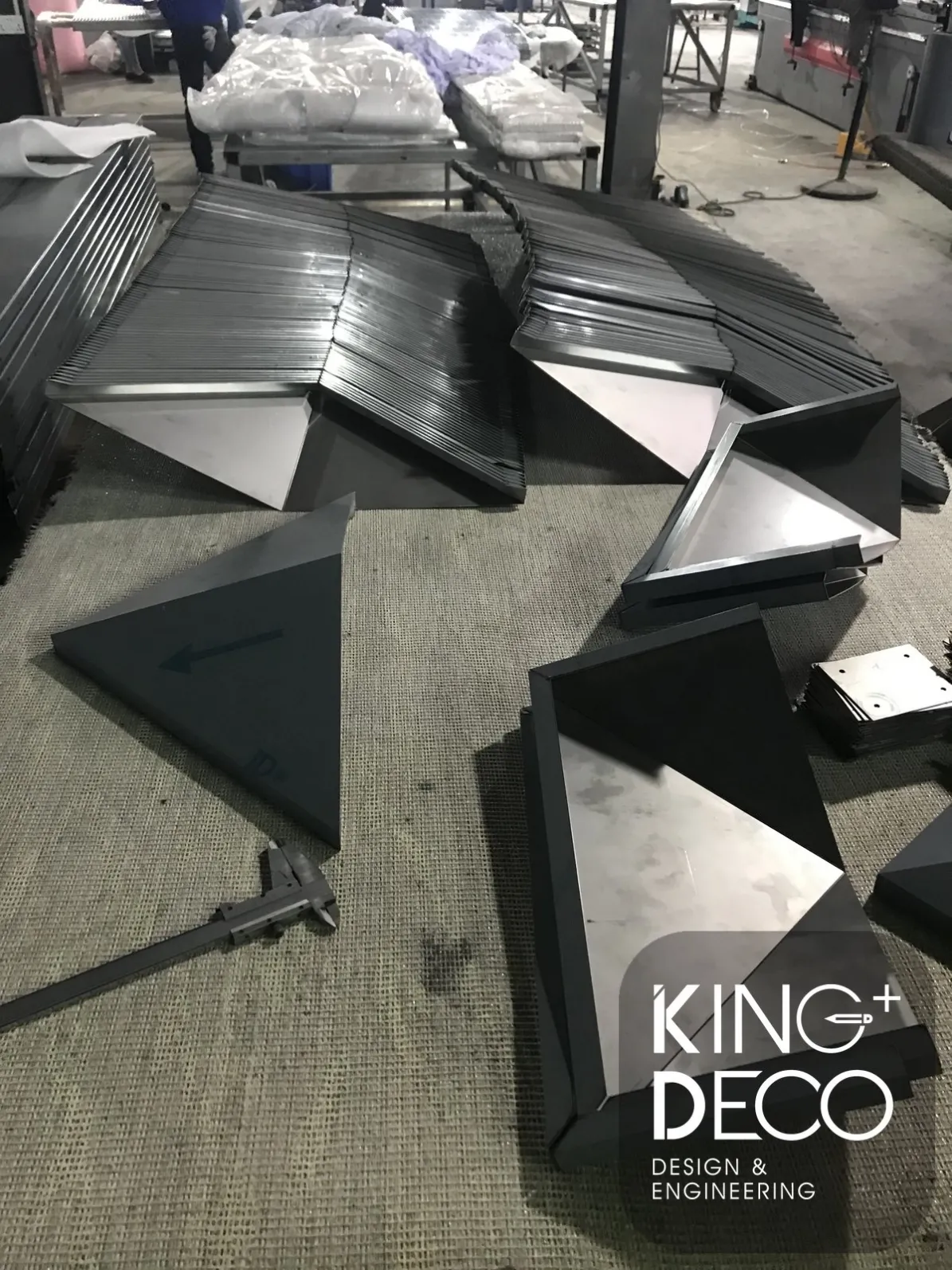
A package of one-offs
Bespoke architectural metalwork is not serial production. A decorative package for one hotel lobby can contain hundreds of components where no two are identical: curved panels that each follow a different radius, framed infills cut to individual openings, transition pieces that reconcile a metal system with glass or stone set by another trade. The unit of manufacture is the component, not the product.
Scale makes this concrete. KingDeco's interior brass cladding package for the Australian War Memorial in Canberra covered 2,700 m² and comprised more than 3,000 fabricated components, tracked through a five-point coding system covering more than 2,000 unique part codes, linking each component to its drawing, its position and its carton. Packages of that size turn traceability from an administrative nicety into the load-bearing structure of the project.
What traceability has to answer
A coding system is only as good as the questions it answers quickly. On a live package, four questions recur:
- Which drawing does this part belong to? When a site query arrives with a photograph, the code on the part must lead back to the exact drawing revision it was fabricated to.
- Where does it go? Not approximately — the position code identifies the installed location, which matters when two visually similar parts differ by a mm-scale detail.
- Which crate is it in? During installation, parts are hunted by crate. Unlabelled crates turn a sequenced install into an excavation.
- Can we remake it? Months after handover, damage or a design change requires one replacement part. The remake path — code to drawing to material and finish specification — determines whether that takes days or weeks.
How the code travels through production
At KingDeco the component code is assigned at drawing development and then carried physically through every stage. It appears on the nesting sheet when the part is laser-cut, on the fabrication traveller that follows it through bending, welding and grinding, at the assembly check where interfaces are verified, in the finishing batch records, and finally on the crate label and packing list. A part that leaves the factory without a code at any stage is a part that will cost someone time later.
The discipline pays off most at the edges of the process. At trial assembly, coded components are checked against their interfaces — so the code is proven against the parts around it, not just against its own drawing. At packing, crate labels follow the installation sequence: the site team receives containers in the order the design is built, and each carton declares its contents by code. Installation then proceeds from the packing logic rather than from on-site detective work.
Traceability and quality records
Codes are also the spine of quality documentation. Inspection results — weld inspection, surface checks, finish-batch comparison against approved samples — attach to component codes, so a quality record can be produced per part on demand. For PVD-finished packages, finish batch records connect physical parts to coating runs, which is what allows a later remanufacture to match the original colour instead of guessing at it. That connection between traceability and finish consistency is covered in PVD batch acceptance and sampling.
For the contractor, this is also where accountability lives. When questions arise months after completion — was this interface checked, which batch supplied this panel — the answer is a lookup, not an argument.
What to ask a fabricator before award
Traceability is easy to promise and expensive to retrofit. Practical pre-award checks:
- Ask for a sample coding scheme, applied to a real package: how a part code reads, and what each element of it refers to.
- Ask how crates are labelled and sequenced — the packing list should be an installation document, not a shipping formality.
- Ask what happens on a remake: the answer should start with a part code, not with photographs and guesswork.
- Ask how quality records attach to codes, including finish batch references for coated work.
The payoff
Projects do not stay tidy. Drawings get revised, crates get opened out of sequence, parts get damaged. On a well-coded package each of those events is a five-minute lookup; on a poorly coded one, each is a site meeting. The War Memorial package ran its 3,000+ components through factory trial assembly and coded dispatch — the traceability work is what made pre-assembly meaningful rather than theatrical. The pre-assembly side of that project is covered separately: Factory pre-assembly of architectural metal components and How factory pre-assembly reduces installation risk.
If your package involves hundreds of unique components and you want a manufacturing partner who works to a component-level coding discipline, discuss your project with KingDeco — send us your drawings for a technical review and quotation.